
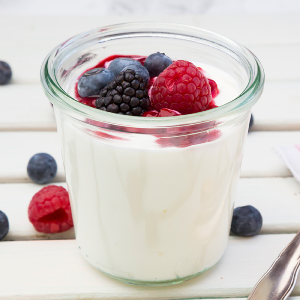
Yogurt
(n)Yogurt also spelled yoghurt, yogourt or yoghourt, is a worldwide popular food.
Xem thêmThe fermentation of lactose by these bacteria produces lactic acid, which acts on milk protein to give yogurt its texture and characteristic tart flavor.
Xem thêmThe bacteria used to make yogurt are known as yogurt cultures.
Xem thêmThese are the "good bacteria" responsible for all of yogurt's health benefits.
Xem thêmYogurt is highly nutritious and is an excellent source of protein, calcium and potassium.
Xem thêmThe most recent etymology of the word yogurt certainly comes from the Turkish language (meaning to knead or mix with a utensil).
Xem thêmNobody knows when yogurt was discovered, its origins have been lost in the mists of time.
Xem thêmLegend tells that yogurt was discovered because a shepherd, forgetting some milk in one of these skins for a while, when he finally remembered it, found it transformed : into something denser and tastier.
Xem thêmApart from the legend, the most likely inventor of yogurt was yogurt itself.
Xem thêmAs far as Yogurt is concerned, it is easy to isolate the main cause of fermentation in the organisms present in the animal skins used as containers.
Xem thêmThe continuous migrations of the tribes from the East European Steppes brought about the spreading of yogurt in the Mediterranean area.
Xem thêmLater on, during the warring campaigns of the Phoenicians, the Egyptians, the Greeks and the Romans, yogurt became common in the entire West.
Xem thêmThe oldest writings mentioning yogurt were by Pliny the Elder, who said that some people knew how to thicken the milk into something which was sour but tasty.
Xem thêmYogurt was brought to the US in the early 1900s and steadily increased in popularity as a health food item over the next several decades.
Xem thêmIsaac Carasso industrialized the production of yogurt.
Xem thêmIn 1919, Carasso, who was from Ottoman Salonika, started a small yogurt business in Barcelona, Spain, and named the business Danone ("little Daniel") after his son.
Xem thêmYogurt with added fruit jam was patented in 1933 by the Radlická Mlékárna dairy in Prague.
Xem thêmToday, to produce yogurt, milk is first heated, usually to about 85 °C (185 °F), to denature the milk proteins so that they do not form curds.
Xem thêmGreek yogurt is made by straining out the extra whey in regular yogurt.
Xem thêmIt makes a yogurt that's thicker, creamier and tangier than regular yogurt.
Xem thêmVarious flavors and sweetening may be added, or natural yogurt may be mixed with fresh fruits or vegetables.
Xem thêmFrozen yogurt is a frozen dessert made with yogurt and sometimes other dairy and non-dairy products.
Xem thêmA salad of yogurt, cucumbers, and spices is served in India (raita) and several Middle Eastern countries (jajik) and Greece (tzatziki or tarator).
Xem thêmYogurt is also used in soups and sauces.
Xem thêmCrema D'or, from Hokkaido, is apparently the world's most expensive yogurt.
Xem thêmThe milk and honey yogurt has a rich, cream cheese-like texture.
Xem thêmNational Greek Yogurt Day is observed annually on November 9th.
Xem thêmNational Frozen Yogurt Day is observed annually on February 6th.
Xem thêmYogurt is cold and sweet.
Xem thêm