
Orbit

Meaning
The curved path of a celestial object or spacecraft round a star, planet, or moon, especially a periodic elliptical revolution.
Pronunciation
UK ˈɔːbɪt
US ˈɔːrbɪt
Example Sentences
- Because of Uranus's odd movements in its orbit (the line which a planet follows in moving), it made astronomers search for the new planet.
- It takes our solar system about 230 million years to complete one orbit around the galactic center.
- Beyond the orbit of Neptune (the furthermost planet), it takes a long time to leave the Solar System.
- More than 300 robotic spacecraft have explored destinations beyond Earth orbit.
- They sent 2 Nexus S handsets running Android Gingerbread into space to test their sensors in orbit aboard the International Space Station.
- Satellites launched into orbit now allow us to use GPS navigation on our phones.
- Space telescopes orbit above Earth's atmosphere, which blocks some types of light.
- Because [Earth] and [Mars] orbit the [Sun] at different speeds, the distance between them swings from about 55 million to over 400 million kilometers.
- Instead, engineers prefer a minimum-energy path called a transfer orbit, a graceful arc that intercepts [Mars] months after launch.
- Achieving orbit means acquiring enormous sideways speed, falling toward [Earth] continuously while the [planet's] curvature drops away beneath you.
Learn Orbit in Context
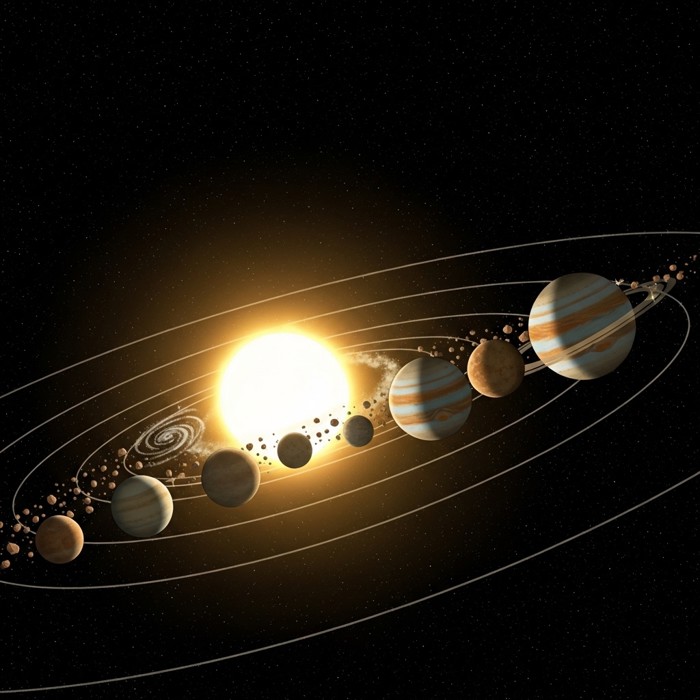 A Simple Look at the Solar SystemThe solar system is so large that light takes over eight minutes to travel from the Sun to Earth. It is made up of the Sun, eight planets, and many smaller objects such as moons and asteroids. The Sun...Read story
  Why the Moon Always Shows Us the Same FaceThe Moon has kept one face turned toward us for billions of years, like a dancer who never turns her back on the audience. This eternal sameness is not a coincidence but the result of a subtle gravita...Read story
Explore more
Practice Orbit
Read, listen, and practise using “Orbit” in fun stories and activities.